Sunday, March 28, 2010

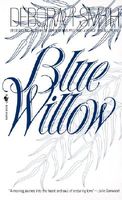
Blue Willow

Blue Willow
Deborah Smith

I bought this because I liked the design on the spine. It turns out to be a promotional copy, and has lots of funny typos, but it still manages to be five hundred and thirty-three pages of readable plot, which I finished in three days.

The story follows the lives of Lily MacKenzie, a muscular, independent red-headed farm girl from small-town Georgia, and Artemas Colebrook, heir to a broken family and a bankrupt china company. To him, Lily has always symbolized goodness, security, and his real home. To her, Artemas is the lost prince who will come back to a hard world and restore what was unthinkingly squandered and broken. Both dream of the time when they can be together, enjoying treasured home. But the hard, cold world has other plans.

When still a boy, Artemas realizes the destruction and cruelty of his parents and decides to protect and raise his five younger siblings. His grandmother trains him in the family business and leaves it to him when he is barely out of adolescence. He vows to do what is best for his family and restore their crushed legacy, no matter what the cost. It's an unrelenting vow, even when he realizes it means he must give up Lily.

She grows up with hard work and the pure love of her parents, writing encouraging letters to the older boy she met as a child. But when her parents are killed in a terrible accident and Artemas ignores her attempts at contact, her world is shattered. Bitter and grieving, she leaves her home to fight out a new life in Atlanta.

And so their worlds separate into difficult lives. Until Artemas moves the headquarters of the now fabulously successful family corporation to Atlanta, and hires Lily's husband to design the building. On opening day, the building crumbles, killing Lily's husband and son, maiming Artemas's brother, and killing his sister. Hatred and blame reawaken the old wounds between Lily and Artemas, resurrecting the pain of lost dreams as well.

But this is a romance novel (yeah, I was tricked by the cover copy), so everything is likely to turn out happily, even if it takes more than five hundred pages of angst, shouting, misunderstanding, and sex to do it.

The main characters are believable enough to root for, but many of the minor characters are not well developed. There are several scenes and veins of domestic abuse, but they do not make the kind of deep impact on the plot that such a situation does on a real life. Likewise, several other plot points end up being trite or shallow, or just don't really make sense. Multiple times I read a passage with the feeling that it was there just because the author needed it to be, rather than because the characters believably would have taken that course.

That being said, I did enjoy the book, overall. It was written as entertainment, and it entertained me. I'm not likely to read it again, but it was worth my metro time for a couple of days.

Saturday, March 20, 2010

North of Ithaka

North of Ithaka
Eleni Gage

By time she turned twenty-seven, Eleni Gage was tired of the not-so-subtle hints of her loud, superstitious aunts about marriage. But she wasn't tired of the stories they told of their childhood home, even though they broke off darkly with the invasion of the German army in WWII.

Eleni knows their home was turned into the headquarters of the army and used as a prison, torture chamber, and burial ground for those executed, including her grandmother. She knows the house has since fallen into ruin. And she knows the past is calling her.

Funded by her father and fueled by a desire to understand their family's tragic past and somehow redeem the future, she leaves a career as a New York journalist and moves to Lia, a a tiny village in northern Greece. There she navigates local custom (such as sacrificing a rooster on the foundations of a new house), stubborn tempers, and fights against squirrels to dig up and restore her family's past, revere the memory of her grandmother, and rebuild the family home. Along the way she learns to cook, how to balance superstition and orthodox religion, and what it means to be a Northern Greek.

Eleni's writing is frank and clear, recounting her mistakes, frustrations, revelations, and good times. Her descriptions of Greek village life are thoughtful and entertaining, and the neighbors never fail to be kind, loud, and overly concerned with everyone's business. As a bonus, Eleni includes recipes for many of the ritual foods mentioned throughout the book, such as rooster stew. It's not a page turner, but North of Ithaka is just the thing if you want a light, satisfying read.

Sunday, March 14, 2010

The Wheel on the School

The Wheel on the School
Meindert DeJong

I loved this book as a child (as well as several other books by this author), so when I saw it in a used book store I picked it up right away. Then I brought it home and read it all in one day. It's one of those books for children that is so delightful that one never outgrows it. Besides, three of the main characters are elderly.

Lina is the only girl in her tiny six pupil school. One day she writes an essay about storks. They nest on her Aunt's house in a neighboring town, but none of the lucky birds grace their Dutch fishing village. Lina, the teacher, and the five boys set out to investigate why. It is decided that they need to put a wagon wheel up on the steep roof so the storks have something to nest on. But can they find one?

Their search takes them all over the countryside, where they meet unexpected allies, nearly drown several times, and finally succeed in finding a wheel. But a major storm is killing the storks, migrating over the sea from Africa. Will any survive? Will any choose the little town of Shora for their new lives? They will if the townsfolk and the children have anything to say about it.

Warm, fresh, and lively, The Wheel on the School is a delightful tale of community, overcoming fear and prejudice, and the power of beliving in the impossible.

Besides, it's illustrated by Maurice Sendak. How could it get any better than that?

Saturday, March 13, 2010

Alentejo Blue

Alentejo Blue
Monica Ali

Set in a hot summer of rural Portugal, Alentejo Blue follows the colored threads of different lives as they cross and recross in the tangle of small town life. There are those who have lived in Mamarrosa their entire lives, those who left and came back full of wisdom about the greater world, and those who fled their lives in other places for the exotic quiet of a foreign village. A drunk English writer, an engaged couple, a destitute family, a fat chef. Each character wrestles through quirks and needs to make decisions, sometimes whether to go abroad, sometimes whether to light a match. Their decisions form patterns in the village tapestry.

Unfortunately, none of the characters were compelling: small town folk making difficult mistakes and not resolving anything. The only person I found myself rooting for was the girl who was going abroad to work; disappointing in a book about a village. And, characteristically, even she makes terrible decisions and is ignored by the consequences. Lack of resolution gave an otherwise promising book a flabby, unfinished feel. It's a pity; the title was so intriguing.

Tuesday, February 16, 2010

The Dispossessed

The Dispossessed
Ursula K. LeGuin

Shevek is brilliant young physicist working on a theory that will allow instantaneous space travel (teleportation!). He's also an Odonian, part of a socialist anarchist society living on the harsh moon of his peoples' home planet. But moneyless settlers fighting dust and famine for survival are not overly interested in teleportation. For the sake of his research and to bridge the gulf between the society they left and the one they created, Shev takes an unprescedented journey to earth, hoping to tear down walls and trade his theory for mutual cooperation and freedom.

Woven into Shev's experiences with earth technology, style, customs, and depravity are chapters about his youth, family, culture, and the events which led to leaving his home. LeGuin's descriptions are creative and compelling, and the characters are memorable, but the best part of this book is seeing the world through the eyes of an outsider.

The childlike simplicity and trust that Shevek has, his expectation that people will do right by each other and his surprise at being cheated and manipulated harkens to the stories fondly told of Soviet times. "See, Soviet people were very kind to each other, and did not expect to be cheated. It was easy to scam them, because they didn't even think of such a thing." "In Soviet times, people helped each other, shared what they had with their neighbors. It was a community." Even so, this is not a romantic anarchist utopia; LeGuin does not sugar coat the harshness and flaws of the Odonian society. We are left with a startling picture of what happens when people focus on one aspect of human nature and stretch it into encompassing morality.

I am afraid that if I keep writing, I'll degenerate into rambling. But first, I have one last thing to say: I really want Shev's teleportation technology.

Monday, February 15, 2010

Anil's Ghost

Anil's Ghost
Michael Ondaatje

Michael Ondaatje's stories have the feeling of a sepia photograph; they're rich, real, and yet hallowed by lack of color. His prose lives in sparse details. A water drop falls from a leaf, a woman sighs, a headlight blinks a man into consciousness for a second. The world turns. Evil in chaos, scientists and artists struggling to create. Risking their next moment in a sepia photograph to show up in truth.

He haunts me, flashes of a ghost barely not seen. And yet the story is very solid, gritty, terrible and beautiful and full of soil as well as soul. Anil's Ghost is a mystery, a mystery about government killings in Sri Lanka, a mystery about an unsual skeleton, a mystery of choices, conscience, and survival. It's about Anil, who left. Sarath, who retreated into cynicism and the archeology of ancient temple ruins. Gamini, who hides in drugs and twenty-hour shifts in the ER. And whether it is possible to do anything but survive in the face of constant murder and betrayal.

Tuesday, February 9, 2010

Oh, Dear

A two week long roaming vacation with one's brother all over the UK is fantastic for the soul, but not for reading. Particularly since we each had only a small backpack as luggage. And then work ate me. So.

I will do my best to review these books in the next couple of weeks...

January booklist:

To Swim Across the World, Francis and Ginger Park
*The Firstborn Advantage: Making your birth order work for you, Dr. Kevin Leman
*Blue Like Jazz, Donald Miller
The Last Samurai, Helen DeWitt
Anil's Ghost, Michael Ondaatje
*The Kingdom by the Sea, Paul Theroux
The Dispossessed, Ursula K. LeGuin


*denotes a book I read for the first time